
Automatic Mustard Oil Press Machine Price in Bangladesh | Direct Importer
Automatic Mustard Oil Press Machine Price in Bangladesh | Direct Importer
Are you planning to start a mustard oil production business or upgrade your existing oil mill in Bangladesh? Choosing the right automatic mustard oil press machine is one of the most important decisions for building a profitable and efficient oil processing business.
Mustard oil is widely used in Bangladeshi households, restaurants, food businesses and traditional cooking. As demand for locally processed mustard oil continues to create opportunities for entrepreneurs, investing in suitable oil extraction machinery can help businesses establish their own production facilities, improve processing efficiency and develop a recognizable oil brand.
However, purchasing an oil press machine involves more than comparing prices. You need to consider processing capacity, motor power, electricity requirements, seed compatibility, oil extraction performance, filtration systems, machine durability, spare parts availability and the overall investment required for your production facility.
Total Import Solution provides machinery sourcing and import assistance for businesses in Bangladesh. We help customers explore international machinery options and arrange import solutions according to their technical requirements and business needs.
Whether you need a small automatic mustard oil press machine, a commercial oil expeller or a complete mustard oil mill plant setup, choosing the correct machinery configuration is essential.
Contact Total Import Solution to discuss your requirements and request a customized quotation.
- WhatsApp: +880 1883-037337
- Email: info@totalimportsolution.org
- Website: https://totalimportsolution.org/
What Is an Automatic Mustard Oil Press Machine?
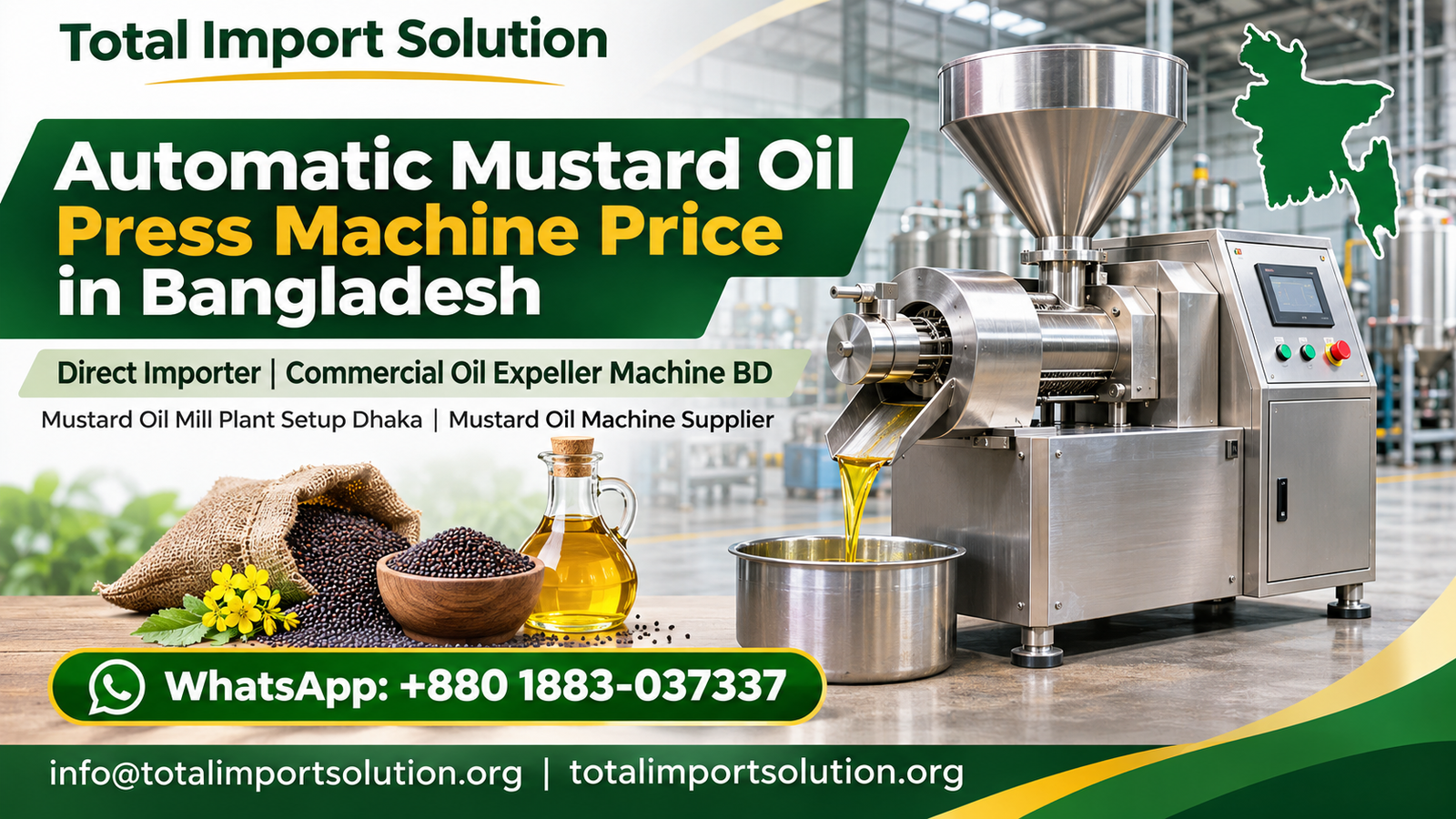
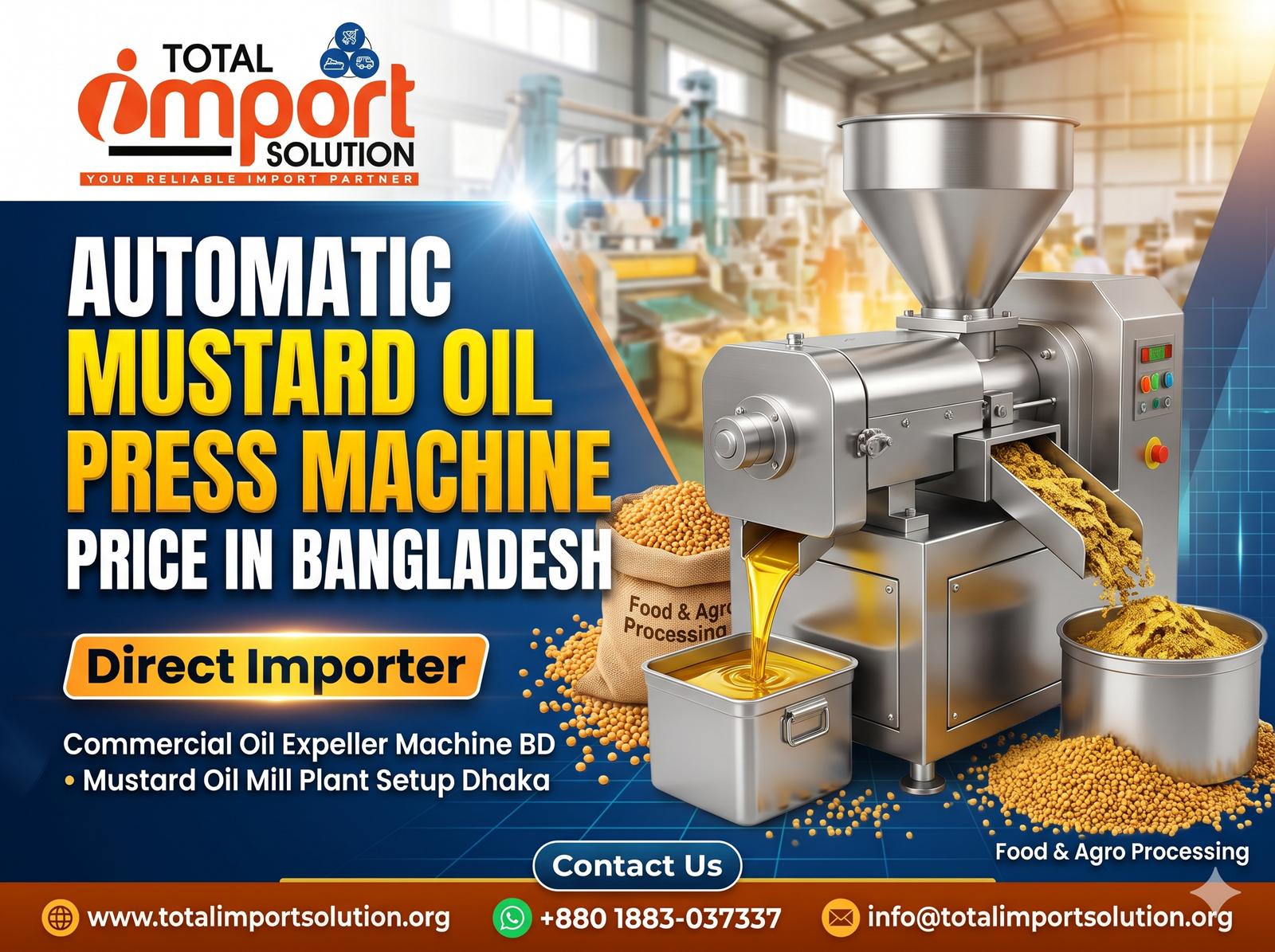
An automatic mustard oil press machine is an industrial or commercial processing machine designed to extract oil from mustard seeds through mechanical pressing.
The machine generally uses a rotating screw mechanism, also known as a screw expeller, to compress mustard seeds inside a specially designed pressing chamber. The pressure separates liquid oil from the solid seed material.
The extracted oil is collected through designated outlets, while the remaining solid material, commonly known as mustard oil cake or khoil, is discharged separately.
Depending on the machine design, additional features may include:
- Automatic seed feeding.
- Motor-driven screw pressing.
- Temperature control or heating arrangements.
- Oil collection systems.
- Oil cake discharge mechanisms.
- Integrated or separate filtration systems.
- Automatic control panels.
- Production monitoring facilities.
The actual automation level depends on the selected model. Some machines automate the pressing process but still require manual seed feeding, filtration, collection and packaging.
For this reason, buyers should distinguish between a fully automatic production line and a semi-automatic oil press machine before making an investment.
Mustard Oil Press Machine Price in Bangladesh
One of the most common questions from potential buyers is:
How much does an automatic mustard oil press machine cost in Bangladesh?
The answer depends on the machine's capacity, manufacturing quality, automation level, motor configuration, included accessories, country of origin and import arrangements.
A small commercial oil press and a complete industrial mustard oil production line are two very different investments.
The following factors should be considered when requesting a price quotation.
1. Production Capacity
Production capacity is one of the biggest factors affecting machine pricing.
A smaller machine may be suitable for a local mustard oil shop, while a higher-capacity machine may be more appropriate for commercial production and wholesale distribution.
Always check whether the supplier specifies capacity in kilograms of mustard seeds processed per hour or litres of oil produced per hour.
These measurements are not interchangeable.
2. Motor Power and Electrical Requirements
The motor drives the pressing screw and determines the machine's operating capability.
Before purchasing, check:
- Motor power in kW or HP.
- Required operating voltage.
- Single-phase or three-phase connection.
- Electricity consumption.
- Starting current.
- Motor protection system.
- Continuous operating capability.
For commercial buyers, checking the electrical infrastructure of the proposed factory is particularly important.
3. Machine Construction and Material
Machine construction affects durability, maintenance requirements and suitability for food processing.
Pay attention to:
- Pressing chamber material.
- Screw and barrel construction.
- Quality of metal components.
- Food-contact surface material.
- Corrosion resistance.
- Welding and finishing quality.
- Ease of cleaning.
Where oil-contact components are made from stainless steel, ask the manufacturer to confirm the actual stainless steel grade and material documentation.
4. Automation Level
Automatic machines generally offer more convenient operation than basic manual systems.
However, the word automatic does not necessarily mean that every production stage is automated.
Ask whether the quoted machine includes automatic feeding, pressing, temperature monitoring, filtration and packaging.
5. Filtration and Additional Equipment
An oil press extracts oil, but the freshly extracted oil may contain suspended seed particles and other residues.
A separate filtration system may therefore be required to produce a clearer finished product.
Additional equipment can increase the overall investment but may improve production efficiency and reduce manual work.
Request the Latest Machine Price
Total Import Solution can help you explore machinery options based on your desired capacity, machine configuration and budget.
Since prices depend on the selected model and import arrangements, contact us for a current quotation instead of relying on an outdated online price.
Get a quotation:
WhatsApp: +880 1883-037337
Email: info@totalimportsolution.org
Website: https://totalimportsolution.org/
Types of Mustard Oil Press Machines Available for Commercial Use
Different oil extraction technologies are available for businesses with different production requirements.
Understanding their differences can help you select machinery that matches your business model.
1. Screw Type Mustard Oil Expeller Machine
A screw-type oil expeller is a common option for continuous mechanical oil extraction.
It operates through a rotating screw inside a pressing chamber. As mustard seeds move through the chamber, increasing mechanical pressure helps separate oil from the solid material.
Main features:
- Continuous pressing operation.
- Motor-driven extraction.
- Commercial production applications.
- Relatively compact configurations.
- Potential compatibility with multiple oilseeds, subject to machine specifications.
Suitable for:
- Small and medium oil mills.
- Local oil production businesses.
- Commercial mustard oil processing.
- Entrepreneurs entering the edible oil market.
The exact output and extraction performance depend on the seed quality, moisture level, machine design and operating conditions.
2. Automatic Mustard Oil Press Machine
An automatic mustard oil press machine is designed to reduce manual involvement in the pressing operation.
Depending on the model, it may include automatic feeding, motorized pressing, control panels and monitoring systems.
Advantages:
- Reduced manual operation.
- More consistent operating procedures.
- Improved workflow.
- Potentially higher production efficiency.
- Convenient operation for commercial users.
Before ordering, confirm precisely which functions are automated.
3. Cold Press Mustard Oil Machine
Cold pressing is a mechanical extraction approach designed to limit excessive heat generation during oil extraction.
It is often selected by businesses targeting premium mustard oil products.
Important considerations:
- Operating temperature.
- Pressing speed.
- Seed preparation.
- Heat generated through friction.
- Product quality testing.
- Accuracy of cold-pressed product claims.
Not every machine advertised as a cold press maintains the same temperature conditions. Ask the manufacturer for operating temperature information and supporting documentation.
4. Hot Press Mustard Oil Machine
Hot pressing involves preparing or conditioning seeds with heat before or during extraction.
Depending on the process, conditioning may help improve pressing performance and oil recovery.
This type of processing may be appropriate for certain commercial production requirements.
The correct temperature and conditioning procedure depend on the seed characteristics, product specifications and equipment design.
5. Commercial Oil Expeller Machine
A commercial oil expeller is designed for businesses requiring regular processing rather than occasional household production.
These machines may have stronger drive systems, larger pressing chambers and higher processing capacities.
For a commercial oil mill, the machine should be selected according to the expected daily seed supply, production schedule and available electricity.
How Does an Automatic Mustard Oil Press Machine Work?
Understanding the working process is useful when comparing machines and planning an oil production facility.
The general process involves several stages.
Step 1: Mustard Seed Selection
The production process starts with selecting suitable mustard seeds.
The quality of raw materials directly affects the final oil quality and extraction performance.
Good-quality seeds should be:
- Properly matured.
- Free from excessive dust and stones.
- Free from visible mould.
- Properly stored.
- Suitable for edible oil processing.
Different mustard varieties may have different oil contents and physical characteristics.
Step 2: Seed Cleaning
Before pressing, mustard seeds should be cleaned to remove unwanted materials.
Common impurities include:
- Dust.
- Sand.
- Small stones.
- Plant residues.
- Stems.
- Other foreign materials.
A seed cleaner or vibrating screening machine can help improve raw material cleanliness.
A destoner may be added where stones and heavier impurities require separate removal.
Cleaning is important because foreign materials can damage machine components and reduce the quality of the finished product.
Step 3: Seed Conditioning
Mustard seeds may require conditioning to achieve suitable moisture and processing characteristics.
Depending on the selected technology, conditioning may involve controlled drying, moisture adjustment or heating.
Incorrect moisture levels can negatively affect extraction performance.
The recommended operating conditions should be established through supplier guidance and practical testing with the actual mustard seeds intended for production.
Step 4: Feeding the Seeds
Cleaned and prepared mustard seeds are supplied to the machine through a feeding hopper.
In an automatic configuration, a feeding mechanism may control the supply of seeds into the pressing chamber.
Consistent feeding helps maintain stable operation.
Step 5: Mechanical Oil Extraction
Inside the machine, the rotating screw compresses the mustard seeds.
The pressure generated inside the pressing chamber separates the oil from the solid seed material.
The extracted oil passes through designated openings, while the remaining material is discharged as oil cake.
This is the main stage of the oil production process.
Step 6: Oil Collection
The extracted oil flows into a collection tray or storage container.
At this stage, the oil may contain fine solid particles.
It should therefore be transferred to an appropriate settling or filtration system.
Step 7: Oil Filtration
Filtration removes suspended particles and helps produce clearer oil.
Depending on production requirements, the filtration system may include:
- Plate and frame filter press.
- Filter bags.
- Suitable oil filtration equipment.
- Settling tanks.
- Transfer pumps.
The appropriate system depends on production volume and desired finished-product quality.
Step 8: Oil Storage
After filtration, the oil should be transferred into suitable, clean and covered storage tanks.
Food-contact materials should be appropriate for edible oil storage.
Storage conditions should minimize exposure to moisture, dust, heat and excessive light.
Step 9: Bottling and Packaging
The finished mustard oil can be packed into suitable containers.
Common packaging options include:
- Small retail bottles.
- Medium-sized bottles.
- Large bottles.
- Food-grade containers.
- Commercial oil tins.
A packaging line may include filling, capping, sealing, labelling and date coding equipment.
Step 10: Quality Inspection and Distribution
Before selling the finished product, businesses should establish suitable quality-control procedures.
These may include checks for product identity, purity, moisture, relevant chemical parameters, packaging integrity and applicable regulatory requirements.
Proper documentation and quality control help businesses establish customer confidence.
Complete Mustard Oil Mill Plant Setup in Bangladesh
If you are planning to establish a mustard oil production factory, purchasing only an oil press may not be sufficient.
A complete mustard oil mill plant requires several interconnected machines and supporting systems.
The correct configuration depends on daily production targets, available space, raw material supply and the desired level of automation.
Essential Machinery for a Mustard Oil Mill
1. Mustard Seed Cleaning Machine
Removes dust, stones, stems and other unwanted materials before processing.
2. Seed Grading Machine
Separates seeds according to size and helps improve consistency in raw material preparation.
3. Seed Dryer or Conditioning Equipment
Helps achieve appropriate seed moisture and processing conditions.
4. Mustard Oil Expeller Machine
Performs the main mechanical oil extraction operation.
5. Oil Collection System
Collects extracted oil and transfers it to subsequent processing stages.
6. Oil Filter Press Machine
Removes suspended particles and improves oil clarity.
7. Oil Storage Tank
Provides hygienic storage for filtered oil.
8. Oil Transfer Pump
Moves oil between collection, filtration and storage equipment.
9. Automatic Oil Filling Machine
Fills bottles or containers according to the selected packaging requirements.
10. Bottle Capping Machine
Closes bottles securely after filling.
11. Labelling Machine
Applies product labels for branding and product identification.
12. Date Coding Machine
Prints relevant production and batch information on packaging.
Suggested Production Flow
Mustard Seeds → Cleaning → Grading → Conditioning → Oil Pressing → Oil Collection → Filtration → Storage → Filling → Capping → Labelling → Quality Inspection → Finished Product.
A complete plant can be designed as a compact semi-automatic line or a larger integrated production system.
Mustard Oil Mill Setup for Different Business Sizes
Small-scale mustard oil business
A small business may begin with a suitable oil press, basic seed-cleaning equipment, a filtration system and manual or semi-automatic packaging.
This configuration can be appropriate for a local retail shop or a startup with limited production requirements.
Medium-scale mustard oil factory
A medium-scale factory may require a higher-capacity expeller, dedicated cleaning equipment, larger filtration facilities, storage tanks and semi-automatic packaging equipment.
Large-scale mustard oil production plant
A larger industrial setup may include multiple expellers, automated seed handling, industrial filtration, integrated storage, filling and packaging lines.
Production planning should also include electrical infrastructure, material handling, ventilation, maintenance access and quality-control facilities.
How to Choose the Best Mustard Oil Press Machine in Bangladesh
Choosing the right machine requires a careful evaluation of technical and commercial factors.
A low purchase price does not always mean lower overall operating costs.
Consider the following points before placing an order.
1. Determine Your Daily Production Target
Start by calculating how many kilograms of mustard seeds you expect to process each day.
For example, your production plan may be based on:
- 100 kg of mustard seeds per day.
- 300 kg of mustard seeds per day.
- 500 kg of mustard seeds per day.
- 1,000 kg of mustard seeds per day.
These are planning examples, not guaranteed machine capacities.
Your actual machine selection should consider operating hours, downtime and the manufacturer's tested capacity.
2. Check Actual Mustard Seed Processing Capacity
Some manufacturers advertise machine capacities based on different types of oilseeds.
A machine's performance with soybean or groundnut may not be identical to its performance with mustard.
Ask the supplier to confirm mustard-specific processing capacity.
Whenever possible, request a demonstration video or test report using mustard seeds.
3. Calculate Electricity Requirements
Check the motor rating and electrical connection before importing the machine.
If your factory has a limited power supply, selecting an unsuitable motor may create operational problems.
4. Examine the Screw and Pressing Chamber
The screw and pressing chamber experience considerable mechanical stress.
Their material, construction and replacement availability should be evaluated carefully.
5. Check Filtration Requirements
Do not assume that every oil press includes an effective filtration system.
A separate filter press may be necessary for your production requirements.
6. Ask About Spare Parts
Common wear components may include:
- Pressing screws.
- Pressing rings.
- Bearings.
- Seals.
- Motor belts.
- Relevant chamber components.
Ask about spare parts availability and replacement procedures.
7. Check Warranty and Technical Support
Before ordering, request written information about:
- Warranty duration.
- Covered components.
- Excluded components.
- Installation assistance.
- Operating instructions.
- Maintenance support.
- Spare parts arrangements.
8. Compare Total Import Cost
When purchasing machinery internationally, compare the complete landed or delivered cost rather than only the factory price.
Depending on the transaction and import arrangement, the total cost may include:
- Machine purchase price.
- International transportation.
- Insurance.
- Customs duties and applicable taxes.
- Customs clearance.
- Local transportation.
- Installation.
- Additional accessories.
Ask for a clear quotation explaining what is included and excluded.
Why Import a Mustard Oil Press Machine Through Total Import Solution?
Finding a suitable machine from an international manufacturer can be challenging, especially when you need to compare technical specifications, suppliers, transportation and import arrangements.
Total Import Solution is an import and sourcing service provider in Bangladesh.
Our objective is to make international machinery sourcing more accessible to businesses that want to purchase equipment from overseas markets.
1. International Machinery Sourcing
We help customers explore machinery options from international suppliers and sourcing platforms.
Depending on the product, we can explore manufacturers and suppliers from China and other international markets.
2. Requirement-Based Machine Selection
Every business has different processing requirements.
A small oil mill does not necessarily need the same machinery configuration as a large industrial factory.
We can discuss your requirements and help identify suitable machine options.
3. Import Planning and Logistics Support
Importing machinery involves supplier communication, shipping arrangements and relevant documentation.
Total Import Solution provides import-related assistance according to the selected sourcing and shipping arrangement.
4. Door-to-Door Import Solutions
Depending on the shipment, product and applicable import procedures, door-to-door import arrangements may be available.
The delivery scope, applicable charges and documentation requirements should be confirmed in the individual quotation.
5. Customized Machinery Sourcing
If you cannot find a machine matching your exact requirements, you can contact us with your desired specifications.
We can explore sourcing options based on:
- Required processing capacity.
- Machine dimensions.
- Motor power.
- Automation level.
- Material requirements.
- Accessories.
- Budget.
6. Support for Different Business Requirements
Our sourcing approach can support different types of customers, including:
- New entrepreneurs.
- Existing oil mill owners.
- Agricultural businesses.
- Food processing companies.
- Machinery dealers.
- Industrial investors.
- Commercial production facilities.
Visit our website to explore our import services:
https://totalimportsolution.org/
Mustard Oil Production Business Opportunities in Bangladesh
Starting a mustard oil production business can be an interesting opportunity for entrepreneurs who have access to suitable raw materials, processing facilities and distribution channels.
However, success depends on more than purchasing machinery.
A sustainable business requires careful planning across sourcing, manufacturing, quality control, packaging, marketing and financial management.
1. Raw Material Sourcing
Mustard seeds are the primary raw material.
Before investing in machinery, evaluate:
- Local mustard seed availability.
- Seasonal price fluctuations.
- Supplier reliability.
- Transportation costs.
- Seed quality.
- Storage requirements.
Reliable raw material sourcing is essential for maintaining regular production.
2. Production Planning
Develop a production schedule based on your available seeds and expected market demand.
Avoid purchasing an unnecessarily large machine before confirming the quantity of raw materials you can consistently source.
3. Oil Yield and Production Calculation
Oil recovery depends on the mustard variety, seed quality, moisture content, preparation method and pressing technology.
For preliminary business planning, a yield assumption should be treated as an estimate rather than a guaranteed result.
For example, a hypothetical calculation using 1,000 kg of mustard seeds and a 30% oil recovery assumption would produce 300 kg of crude oil before accounting for subsequent processing losses.
This is an illustration only, not a promise of actual machine performance.
A proper feasibility study should use supplier test results and laboratory analysis of the intended raw materials.
4. Mustard Oil Cake as a By-Product
Mustard oil production generates a solid by-product commonly known as mustard oil cake or khoil.
Depending on its quality and applicable safety requirements, it may have commercial applications such as agricultural or animal-feed-related uses.
Businesses should evaluate the intended use and applicable regulations before selling it as a feed ingredient.
Proper by-product management can contribute to overall business efficiency.
5. Packaging and Branding
Packaging is an important part of building a recognizable mustard oil brand.
A professional brand may require:
- Attractive bottle designs.
- Clear product labels.
- Consistent packaging sizes.
- Proper sealing.
- Batch identification.
- Appropriate storage and handling instructions.
Your packaging should comply with applicable Bangladesh food safety and labelling requirements.
6. Distribution and Marketing
Potential distribution channels include:
- Grocery stores.
- Supermarkets.
- Wholesale markets.
- Restaurants.
- Local retailers.
- Online marketplaces.
- Direct-to-consumer sales.
A consistent product quality and reliable supply chain are important for long-term customer retention.
Important Factors Affecting Mustard Oil Production Quality
A good oil press machine is only one part of successful production.
The quality of the final product depends on the entire processing system.
Raw Material Quality
Poor-quality mustard seeds can affect oil characteristics and processing performance.
Select appropriate seeds and maintain proper storage conditions.
Moisture Management
Excessive or insufficient moisture can affect pressing efficiency.
Follow suitable preparation conditions for the selected equipment.
Processing Temperature
Temperature influences oil characteristics and may affect the aroma and flavour of mustard oil.
Businesses producing cold-pressed products should establish and document the actual operating temperature.
Filtration
Suitable filtration helps remove suspended particles.
The filtration method should be selected according to the expected production volume and product requirements.
Storage
Use clean and suitable storage containers.
Avoid unnecessary exposure to moisture, heat, dust and light.
Quality Testing
Establish an appropriate testing programme to verify product quality and compliance with applicable standards.
Do not rely on visual appearance alone to determine edible oil quality.
Importing Mustard Oil Press Machines from China to Bangladesh
China is an important international sourcing destination for industrial and agricultural processing machinery.
Many manufacturers offer different configurations of screw oil presses, filtration equipment and complete oil processing systems.
However, choosing an overseas supplier requires proper technical and commercial evaluation.
What Should You Check Before Importing?
Manufacturer information
Check the supplier's company details, manufacturing experience and product documentation.
Technical specifications
Request a detailed specification sheet containing capacity, power, dimensions, weight and operating requirements.
Machine demonstration
Ask for actual operating videos, preferably showing mustard seed processing.
Commercial quotation
Request an itemized quotation showing machine price, included accessories and applicable shipping arrangements.
Warranty documentation
Ask for clear written warranty terms.
Spare parts
Check whether replacement components are available.
Shipping and customs
Confirm the applicable shipping method, customs documentation, duties, taxes and delivery scope.
Why Import Planning Matters
Incorrect specifications can result in costly operational problems.
For example, a machine designed for a different electrical supply may not be suitable for your factory.
Similarly, a machine advertised with a particular capacity may produce different results when processing mustard seeds.
Proper planning before ordering can reduce avoidable mistakes.
Documents and Compliance to Consider in Bangladesh
Importing machinery and selling edible oil are two separate regulatory matters.
Businesses should identify the requirements applicable to their particular operation.
For machinery imports, relevant considerations may include:
- Commercial or industrial import registration, where applicable.
- Proforma invoice.
- Commercial invoice.
- Packing list.
- Bill of lading or airway bill.
- Customs declaration and clearance documentation.
- Applicable duties and taxes.
- Other product-specific permissions, where required.
For businesses manufacturing and selling edible mustard oil, additional considerations may include:
- Business and trade licensing.
- Applicable food safety requirements.
- BSTI certification or conformity requirements, as applicable.
- Product testing.
- Packaging and labelling requirements.
- Applicable edible oil fortification requirements.
- Factory safety and environmental requirements.
Requirements can change and depend on the specific product and business model. Buyers should verify the latest rules with the relevant Bangladesh authorities and qualified professionals before importing machinery or starting commercial production.
Common Mistakes to Avoid When Buying a Mustard Oil Press Machine
Purchasing industrial machinery without sufficient research can create unnecessary costs.
Here are some common mistakes to avoid.
Mistake 1: Choosing a machine only because it is cheap
A lower purchase price does not automatically mean better value.
Evaluate the machine's construction, specifications, warranty and operating costs.
Mistake 2: Ignoring mustard-specific capacity
Always confirm the processing capacity using mustard seeds rather than relying only on general oilseed specifications.
Mistake 3: Forgetting the filtration system
A complete oil processing facility requires suitable filtration arrangements.
Mistake 4: Ignoring electrical compatibility
Confirm the required voltage, phase and motor power before placing an order.
Mistake 5: Not checking spare parts
Wear components should be available when maintenance is required.
Mistake 6: Buying a machine without a production plan
Calculate the expected daily seed requirement and market demand before selecting the machine.
Mistake 7: Ignoring the total import cost
Consider the full transaction, shipping, customs and delivery expenses.
Mistake 8: Assuming every machine is fully automatic
Ask the manufacturer to explain each automated function.
Mistake 9: Not requesting technical documentation
Always request a proper specification sheet and operating instructions.
Mistake 10: Starting production without checking food regulations
Understand applicable food safety and certification requirements before selling edible oil.
Frequently Asked Questions About Mustard Oil Press Machines in Bangladesh
1. What is the mustard oil press machine price in Bangladesh?
The price depends on machine capacity, automation level, motor power, construction materials, filtration arrangements and import costs. Contact Total Import Solution for a customized quotation based on your requirements.
2. Where can I buy an automatic mustard oil press machine in Bangladesh?
You can contact Total Import Solution for international machinery sourcing and import assistance. We can discuss suitable machinery options based on your required production capacity and budget.
3. Can I import a mustard oil press machine from China?
Yes. Machinery can be sourced from Chinese manufacturers, subject to the applicable import procedures, shipping arrangements and regulatory requirements.
4. Which mustard oil machine is best for a small business?
A compact screw-type oil expeller may be suitable for a small mustard oil business. The final choice depends on daily production targets, available electricity and budget.
5. Which machine is suitable for commercial mustard oil production?
Commercial production generally requires a suitably sized screw expeller with appropriate seed preparation, filtration and storage equipment.
6. What is the difference between an automatic and a semi-automatic oil press?
An automatic machine performs more operations through automated mechanisms or controls. A semi-automatic machine generally requires more manual involvement. Actual features vary by model.
7. Can one oil press machine process mustard, sesame and groundnut?
Some machines support multiple oilseeds. However, processing settings and machine configurations may differ. Confirm compatibility with the manufacturer before purchasing.
8. Does a mustard oil press machine require three-phase electricity?
Not necessarily. Electrical requirements depend on the machine model, motor size and configuration. Check the manufacturer's specifications.
9. Is an oil filtration machine necessary?
Filtration is generally an important part of producing clear, finished mustard oil. The appropriate filtration equipment depends on your production process and quality requirements.
10. What other machines are needed for a mustard oil mill?
A complete facility may require seed cleaners, grading equipment, conditioning equipment, oil expellers, filter presses, storage tanks, transfer pumps and packaging machines.
11. How much space is required for a mustard oil mill?
Space requirements depend on production capacity, machine dimensions, raw material storage, finished product storage, packaging and worker movement. A site layout should be prepared before installation.
12. Can I establish a complete mustard oil mill plant through Total Import Solution?
You can contact Total Import Solution to discuss sourcing individual machines or multiple components for a customized mustard oil processing setup. Availability and the scope of import assistance depend on the requested equipment and quotation.
13. Does Total Import Solution provide international machinery sourcing?
Yes. Total Import Solution provides international product and machinery sourcing and import-related services. Contact the company to discuss your specific requirements.
14. How can I get a mustard oil machine quotation?
Share your required capacity, machine type, electricity supply, preferred automation level and budget through WhatsApp or email. The team can discuss suitable sourcing options.
15. Can I import machinery without directly contacting an overseas manufacturer?
You can use an import and sourcing service provider to assist with supplier communication, procurement and shipping arrangements. The exact service scope should be confirmed before placing an order.
Why Choose the Right Machinery Before Starting Your Mustard Oil Business?
A mustard oil production business involves several interconnected decisions.
The quality of the raw materials, processing equipment, filtration arrangements, storage conditions and packaging systems all contribute to the final product.
Selecting suitable machinery from the beginning can help establish a more organized production process.
Instead of focusing only on the lowest machine price, evaluate the complete solution according to your business requirements.
Whether you are starting a small oil extraction operation or planning a commercial mustard oil factory, proper equipment selection is an important step towards building a sustainable business.
Get Your Automatic Mustard Oil Press Machine from Total Import Solution
Are you searching for a reliable mustard oil machine supplier or looking to establish a complete mustard oil mill plant in Bangladesh?
Total Import Solution can help you explore international machinery sourcing and import options according to your requirements.
Tell us what you need, and we can discuss the most appropriate sourcing approach for your project.
Our contact details
Company: Total Import Solution
WhatsApp: +880 1883-037337
Email: info@totalimportsolution.org
Website: https://totalimportsolution.org/
Request a quotation today.
Discuss your required production capacity, machine specifications, automation level and budget with our team.
Let Total Import Solution help you explore the right machinery sourcing solution for your mustard oil processing business.
Total Import Solution – Your Reliable Importer.